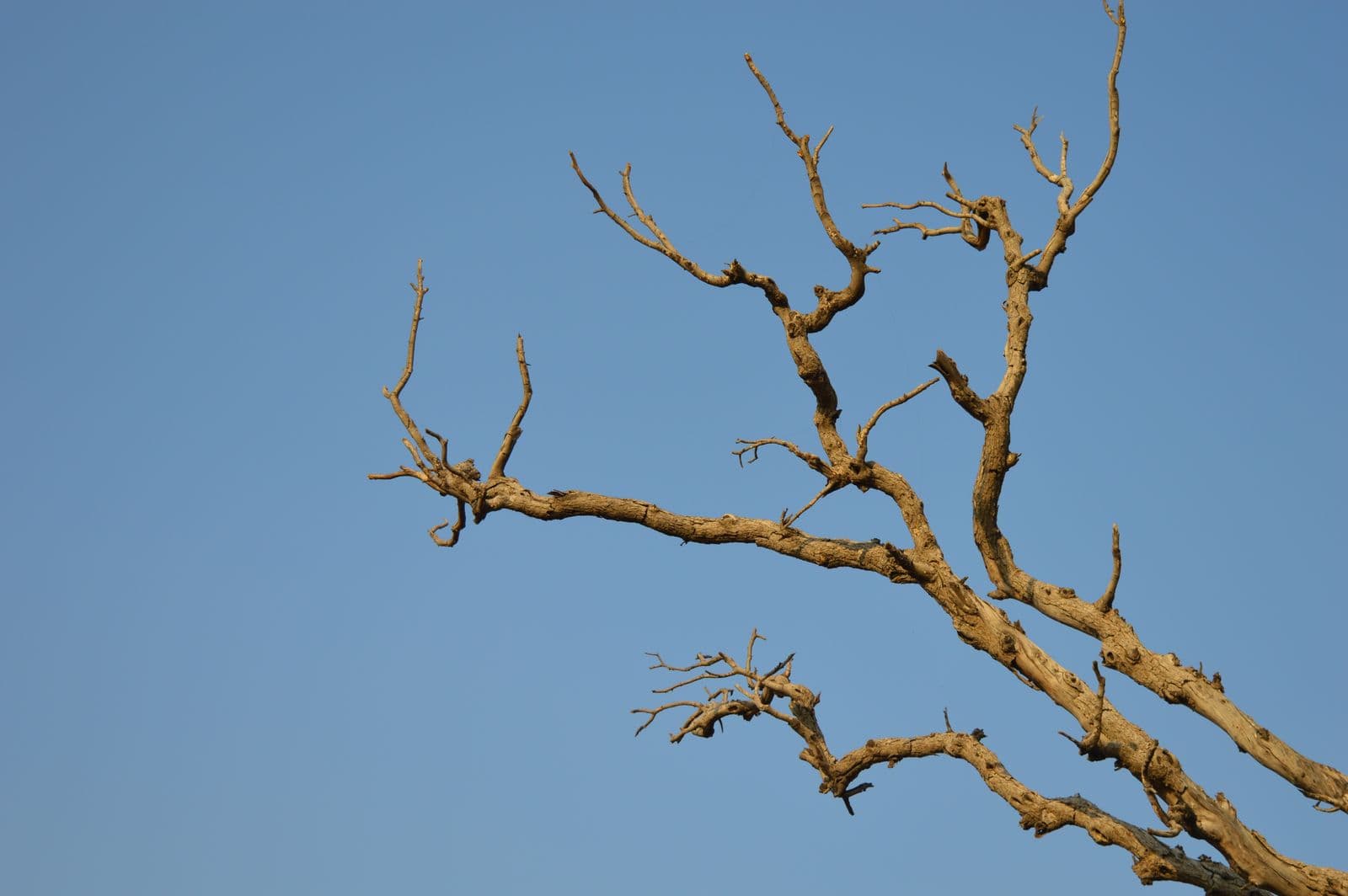
A dead branch or two on an otherwise healthy tree is one of the most common things a homeowner notices — and one of the easiest to misread. Sometimes it's nothing: a lower limb that got shaded out and died back is just the tree doing normal housekeeping. But sometimes a dead branch is the visible edge of something moving through the whole tree, and where the deadwood shows up — and how it's spreading — tells you which situation you're in.
Arborists use a specific term for this: crown dieback, the progressive death of branches usually starting at the outer and upper reaches of the canopy and working inward. Reading dieback correctly is one of the more useful skills a homeowner can pick up, because the pattern of dead branches is often the first warning that a tree is in decline — months or years before it becomes a hazard.
Not All Dead Branches Mean Trouble
Trees shed branches constantly as part of normal growth. A limb low on the trunk that gets overshadowed by the canopy above it will slowly die and drop off — this is called self-pruning, and it's a sign of a tree investing its energy where the light is, not a sign of decline. Interior branches deep in a dense canopy do the same thing. If the dead wood is small, low, scattered, and old, it's usually routine.
What separates normal shedding from meaningful dieback is location, direction, and trend. Deadwood concentrated at the top of the tree, dieback that's clearly getting worse season over season, or large dead limbs on a tree that looked full a year ago — those are the patterns worth paying attention to.
A quick rule of thumb: healthy trees tend to lose branches from the bottom up (shading). Declining trees tend to lose them from the top down and outside in. If the highest branches are the bare ones, take it seriously.
Why Dieback at the Top Is a Warning Sign
The tips of the highest branches are the farthest point from the roots. Every bit of water and nutrient the tree pulls up has to travel the entire length of the trunk and out to those terminal buds. When something compromises the tree's ability to move water — root damage, trunk decay, drought stress, or disease in the vascular system — the parts that starve first are the ones at the end of the supply line. That's why crown dieback so often starts at the top and works down.
In other words, the crown is a kind of dashboard for the whole tree. Dead branches appearing up high are frequently a symptom of a problem happening somewhere you can't see — in the roots or deep in the trunk. This is exactly why a tree care professional evaluating a tree with crown dieback will spend as much time looking at the base and root flare as at the canopy itself.
Seeing dead branches up top?
Get a free AI risk assessment in minutes
Check My Tree Free →Preliminary screening · Takes 3 photos · No account required
What Dead Branches Are Usually Telling You
Crown dieback is a symptom, not a diagnosis — it can come from many underlying causes. Here are the most common ones homeowners run into.
Root problems
By far the most common driver of dieback. Construction that cut or compacted roots, a grade change that buried the root flare, girdling roots strangling the base, soil compaction from repeated traffic, or root rot from chronic overwatering all reduce the tree's ability to take up water — and the crown pays the price. Root damage from work done a few years ago often doesn't show in the canopy until well after the fact.
Drought and heat stress
A run of hot, dry seasons can push a tree past what its root system can supply. The tree responds by sacrificing its outermost, highest growth to conserve water. Dieback from drought is often widespread and fairly even across the crown, and it can show up a year or two after the dry period, not during it.
Disease and vascular pathogens
Certain diseases attack the vascular tissue directly — oak wilt, Dutch elm disease, verticillium wilt, and anthracnose among them. These often produce distinctive patterns: rapid one-sided dieback, wilting that races through the canopy in a single season, or dead branches with streaked or discolored wood underneath the bark. Vascular diseases can be contagious to nearby trees, which makes fast identification important.
Trunk or root decay
When fungal decay hollows out the trunk or major roots, the tree loses both structural strength and its plumbing. Dieback in the crown combined with fungal conks on the trunk, a cavity, or a hollow sound when you tap the base is a serious combination — it points to a tree that is both declining and potentially structurally unsound.
Pests and borers
Wood-boring insects — emerald ash borer being the most notorious — tunnel through the vascular layer just under the bark, cutting off the branches above their damage. Borer-driven dieback often comes with other tells: D-shaped exit holes, S-shaped galleries under loose bark, woodpecker activity, or sprouts erupting from the lower trunk as the tree tries to compensate.
Reading the Pattern of Dieback
The shape of the dieback often points toward the cause and the urgency. Here's how arborists tend to interpret the common patterns.
A few small, low, interior dead branches
LowLooks like: Thin, dead twigs and small branches low on the trunk or deep inside a dense canopy. The upper and outer crown is full and green. The dead wood looks old and weathered.
Risk: Usually normal self-pruning. The tree shed branches that were shaded out. Worth removing the deadwood for safety and appearance, but not a sign of decline on its own.
Progressive dieback from the top down
HighLooks like: The highest branches are bare or dead while the lower canopy is still leafing out. Bare 'stag-headed' limbs poke above the live crown. It's been getting worse year over year.
Risk: A classic decline signal — often root, drought, or vascular stress. The tree is starving its outermost growth. Warrants a professional evaluation to find the underlying cause before it accelerates.
Rapid one-sided dieback in a single season
UrgentLooks like: One side or one major section of the canopy wilts, browns, or dies quickly while the rest looks healthy. Wood under the bark of dead limbs may be streaked or discolored.
Risk: Often points to a vascular disease (oak wilt, verticillium, Dutch elm) or a borer infestation. Some of these spread to neighboring trees. Get it identified quickly — timing matters for both the tree and the ones around it.
Large dead limbs over a target
UrgentLooks like: One or more sizable dead branches — thick enough to do real damage — suspended over a house, driveway, deck, patio, or walkway. May be brittle, barkless, or fungus-covered.
Risk: A direct falling-limb hazard regardless of the tree's overall health. Large deadwood over anything you care about should be removed on a short timeline. Dead limbs fail unpredictably, often in calm weather.
Dieback plus fungal conks or a hollow trunk
UrgentLooks like: Dead branches in the crown combined with shelf-like fungus on the trunk or roots, a visible cavity, or a hollow sound when the base is tapped.
Risk: Decline and structural decay together. The tree isn't just unhealthy — its load-bearing wood may be compromised. This combination is associated with whole-tree or major-limb failure and deserves prompt professional assessment.
Even, widespread thinning across the whole crown
ModerateLooks like: The canopy looks generally sparse or 'see-through' — you can spot more sky through it than you used to — but there's no single dead section. Leaves may be smaller or paler than normal.
Risk: Often chronic stress: drought, compacted soil, buried root flare, or general decline. Rarely an immediate hazard, but a signal the tree needs attention. A soil and root evaluation is usually the right next step.
The Real Hazard: Falling Limbs
Beyond what dieback says about the tree's health, dead branches carry a direct physical risk that's easy to underestimate: they fall. A dead limb has lost the flexibility that lets a living branch bend and shed load in wind. It's brittle, it's often heavier than it looks because of moisture and decay, and it can break free with no warning — including on perfectly still days, a phenomenon arborists sometimes call “sudden limb drop.”
A dead branch that's a foot or two long isn't much of a threat. But a dead limb several inches in diameter, high in the canopy, over a spot where people park, walk, or gather is genuinely dangerous. The height amplifies the impact, and the unpredictability means you can't reliably wait for “a calm day” to deal with it.
Prioritize deadwood by what's underneath it, not just by size. A modest dead limb over a patio where your family sits is a higher priority than a much larger one hanging over an unused corner of the yard. Consequence is half the risk equation.
Can a Tree Recover From Crown Dieback?
Sometimes — and it depends almost entirely on catching the cause early. Dieback driven by a correctable stressor has a real chance of stabilizing. If a buried root flare is excavated, compacted soil is aerated, a young tree is watered through a drought, or a treatable pest is addressed in time, the tree can often halt the decline and slowly push new growth. Trees are resilient when the underlying problem is removed.
But recovery isn't about the dead branches themselves — those won't come back to life, and they'll need to be pruned out. Recovery is about whether the tree can hold the line and stop the dieback from spreading further. A useful marker is the ratio of live to dead crown: a tree that has lost less than a quarter of its canopy has far better odds than one that's more than half gone. Once dieback passes roughly the halfway point of the crown, most arborists start weighing removal against the cost and uncertainty of trying to save it.
The one thing that rarely works is ignoring it. Dieback that has a cause — and it almost always does — tends to progress until that cause is addressed.
What to Do If You Notice Dead Branches
- Note where the dead wood is — top of the crown, one side, scattered interior, or low and shaded. The location is the single most useful clue to whether it's normal or concerning.
- Check the trend — compare to photos from last year or last summer if you have them. Dieback that's clearly spreading is far more urgent than deadwood that's been stable for years.
- Look at the base and roots — because crown dieback is often a root problem, walk the base for a buried root flare, fungal conks, cavities, or soil that's been disturbed or built up.
- Run a preliminary screen — ArborScout's free AI assessment flags canopy dieback, dead limbs, and decay indicators as part of its analysis. Takes 3 photos and no account.
- Prioritize deadwood over targets — any large dead limb hanging over a house, car, walkway, or gathering spot should move to the top of your list regardless of the tree's overall health.
- Get a professional evaluation — for top-down dieback, rapid one-sided decline, or dieback combined with fungal or structural signs, schedule a visit from a tree care professional. Most will assess for free as part of an estimate, and early diagnosis is often the difference between saving and losing the tree.
Frequently Asked Questions
Are a few dead branches on my tree normal?
Why are the branches at the top of my tree dying first?
Will dead branches fall on their own?
Can a tree with crown dieback be saved?
Should I remove dead branches myself?
Is one-sided dieback a sign of disease?
Seeing dead branches up top?
Get a free AI risk assessment in minutes
Check My Tree Free →Preliminary screening · Takes 3 photos · No account required