Most tree care companies give estimates for free, and most of them know, without ever writing it down, that free estimates are one of the most expensive things they do. The truck leaves the yard, someone spends half an hour walking a property, someone else spends twenty minutes turning it into a number, and a good share of the time the answer is no, or silence.
You cannot stop giving estimates. But you can stop driving to the ones that were never going to happen, and in most cases the reason they were never going to happen was knowable before anyone got in the truck. This is a guide to finding those reasons on the phone instead of in the driveway.
What a Free Estimate Actually Costs
Run your own numbers, because they vary a lot by market. As an illustration: say an estimate takes a 45 minute round trip, 30 minutes on site and 20 minutes to write up. That is about an hour and a half per estimate before fuel. If one in three estimates turns into work, every job you win carried four and a half hours of unpaid estimating time with it.
The arithmetic cuts both ways, which is the useful part. You do not need a higher close rate to recover that time. You need fewer trips to the estimates that were going to lose. Skip a third of the dead ends and the same number of jobs costs noticeably less to win, without changing your pricing, your crew or your marketing.
Worth tracking for a month: every estimate visit, and for the ones that did not close, the reason. Most companies that do this find the same three or four reasons account for most of the lost trips, and that most of them could have been caught with one question.
The Trips That Rarely Pay
These are the patterns behind most wasted estimates, and the question or photo that would have caught each one.
The tree is already down
The tell: "A tree came down in the storm and we need it gone." Once the tree is on the ground the hard part is over, and the customer is often shopping for the cheapest haul away, or already has a neighbor with a chainsaw lined up.
Catch it with: A photo of what is actually there, and whether anything is damaged or blocked. A trunk across a roof is a real job. Logs on a lawn may not be your job.
In ArborScout: When the customer's notes read as though the tree is already down, or the only work mentioned is a stump, the request is marked on your job list before you open it.
The job is smaller than it sounded
The tell: "A big branch is hanging over the driveway" turns out to be one limb a pole saw could reach. Customers describe how worried they are, not how big the work is.
Catch it with: A photo from far enough back to see the whole tree with the house or a car in frame for scale.
In ArborScout: One small tree, a routine trim and nothing structural in the photos gets flagged as a small single-tree job that may land under your minimum.
Access will not take your equipment
The tell: Back yard trees behind a fence, a narrow side yard, a slope, a septic field or a pool between the gate and the tree. The job may still be doable, but not at the price or with the setup you assumed.
Catch it with: Ask where the tree is and how you get to it, and for one photo of the route from the street. Ask whether there is a gate and how wide it is.
In ArborScout: The intake asks where the tree sits on the property and whether there is a gate, and a back yard or gated tree raises access as something to confirm before you quote.
The job needs gear or qualifications you do not have
The tell: A tall removal over a house with no drop zone that really needs a crane, or a tree tangled in power lines. Work near energized lines belongs to line-clearance qualified crews, and often starts with a call to the utility rather than to you.
Catch it with: A photo of what is under and around the tree, and a direct question about any wires running through or near the canopy.
In ArborScout: Tree size, height and nearby structures or power lines feed a complexity rating, and large removals get a likely equipment list, crane included when the photos point that way.
The person asking cannot say yes
The tell: A renter worried about a tree, or one of two neighbors who disagree about whose tree it is and who pays. You can give a great estimate and still never hear back.
Catch it with: "Are you the owner, and is anyone else involved in the decision?" Asked plainly, it rarely offends anyone.
The address is outside where you want to work
The tell: A good job forty minutes past your usual area, which is fine if it is a large ticket and a loss if it is a small one.
Catch it with: Get the full address before you schedule anything, not when you are already on the road.
Run a tree care business?
See which jobs are worth the drive before you leave the yard
Get Early Access →Branded intake link · Pre-visit brief · Estimate to invoice
What to Collect Before Anyone Drives Out
The goal is not an interrogation. It is the handful of facts that decide whether a visit is worth it, collected while the customer is still motivated enough to answer.
- The full property address, so you can check service area and pull up the lot before you commit.
- What they want done, in their words: removal, pruning, stump, storm cleanup, or "I'm not sure, I'm just worried about it". That last one is a different conversation and often a good one.
- How many trees. A multi-tree property is often the best ticket of the week for a single trip, and you want to know that up front.
- Three photos per tree: the base where the trunk meets the ground, the main trunk, and the canopy from underneath. Add a wider shot if anything sits close to the tree.
- Where the tree is and how you get equipment to it, plus anything in the way: fences, gates, pools, septic, slopes, wires.
- Whether they own the property and who else is involved in the decision.
- How soon they need it. Urgency changes both your scheduling and your price.
The first five are exactly what ArborScout's intake form walks your customer through, so they arrive answered. The last two are still worth a thirty second call, and it is a far easier call when you already know what the tree looks like.
Asking without losing the lead
Speed matters more than anything else here. A customer who just called three tree companies will often go with the first one that gives them something concrete. So ask for photos immediately, by text, while you are still on the call or right after it, and make it work from a phone with no app to install.
Then tell them why. "Send me three photos and I can probably give you a number today, without you needing to be home for a visit" is an offer, not a hurdle. Specific angles get you usable photos. "Send some pictures" gets you one blurry shot of a leaf from the kitchen window.
Three Piles: Quote It, Visit It, Pass on It
With the photos and answers in hand, most leads sort cleanly into one of three piles.
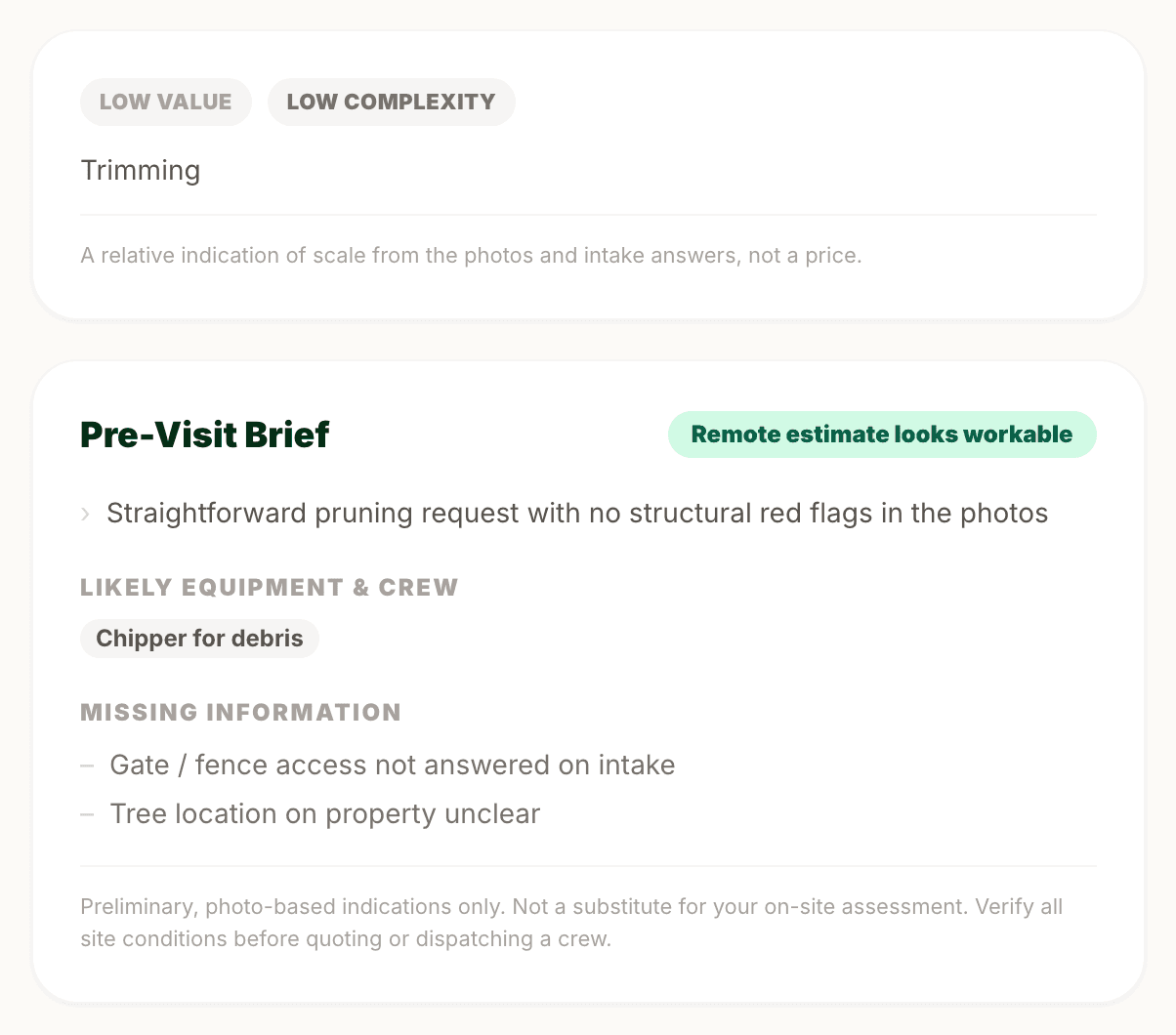
Quote from photos
Straightforward pruning, small and medium removals in open yards, stump grinding, and cleanup where you can see everything that matters. Many companies send these as a range, or a price confirmed on arrival, which keeps the customer moving without locking you into something the photos could not show.
Visit before quoting
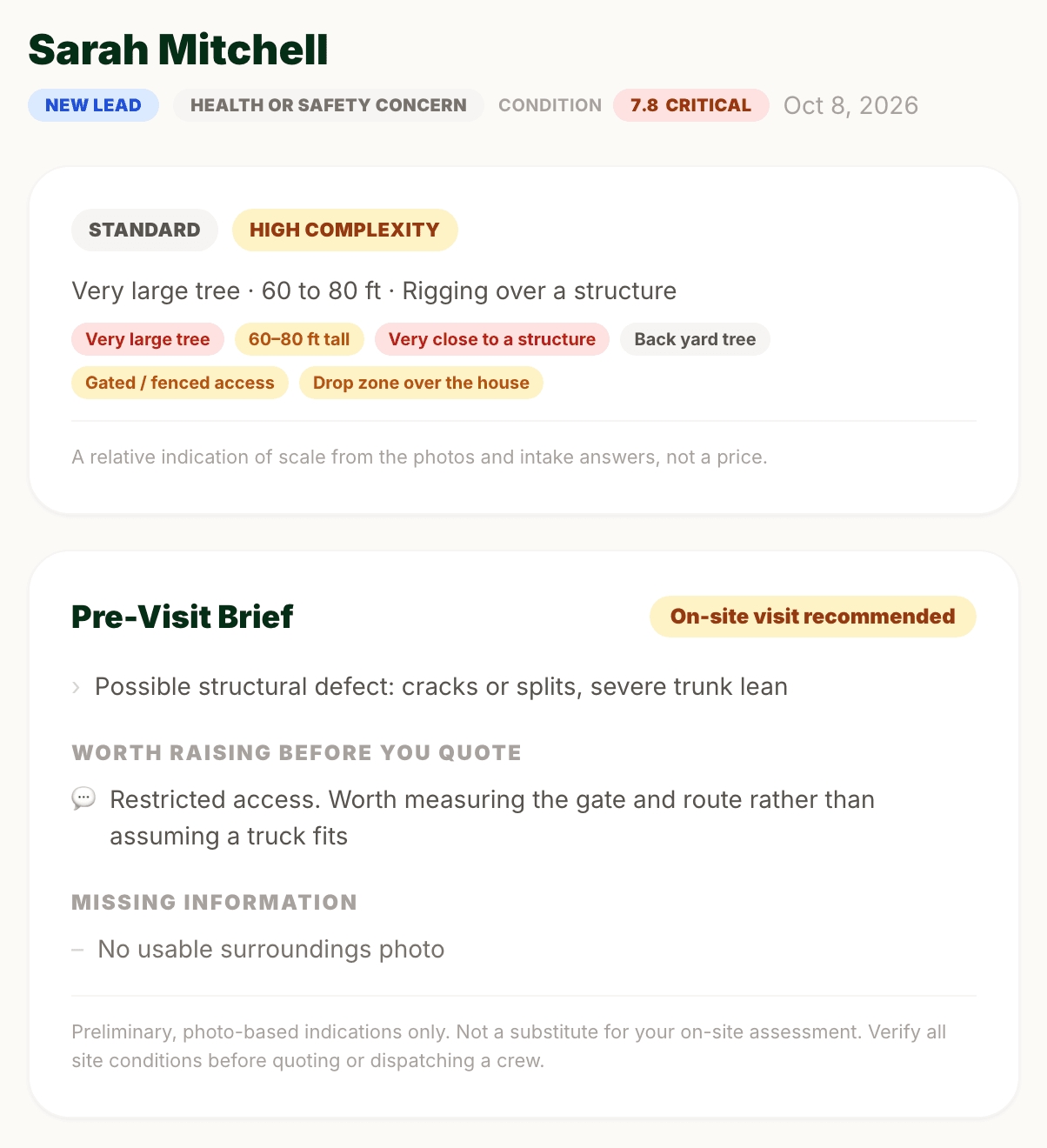
Large removals over structures, anything needing a crane or serious rigging, trees near lines, trees with signs of decay or structural defects, and anything where getting the price wrong would hurt. These are worth the drive, and the photos still help: you arrive knowing what to look at, what equipment to have in mind and what to ask, so the visit is shorter and the estimate goes out sooner.
Pass, refer or price accordingly
Out of area, out of scope, or not a job you want at a price the customer will pay. Passing quickly and politely is a service too. A customer told on day one that this is not your kind of job is far more likely to call you for the next one than a customer who waited a week for a visit that never turned into a number.
Photos do not see inside the tree. Internal decay, a cavity above the first union, a buried utility, a hidden obstacle in the drop zone: the things that change a price most are often the things a photo misses. Use photos to decide which trips to make and to prepare for the ones you do. For hazard trees and complex removals, the site visit is still part of doing the job properly.
Where ArborScout Fits
We built ArborScout around exactly this workflow, so it is worth being specific about what it does and does not do.
You send the customer a link with your company name on it, or a one-time link already labeled with their name. They photograph each tree from three angles, add up to six trees in one submission, and tell you where the trees are, whether there is a gate, and what they want done. Nothing to install and no account for them to create.
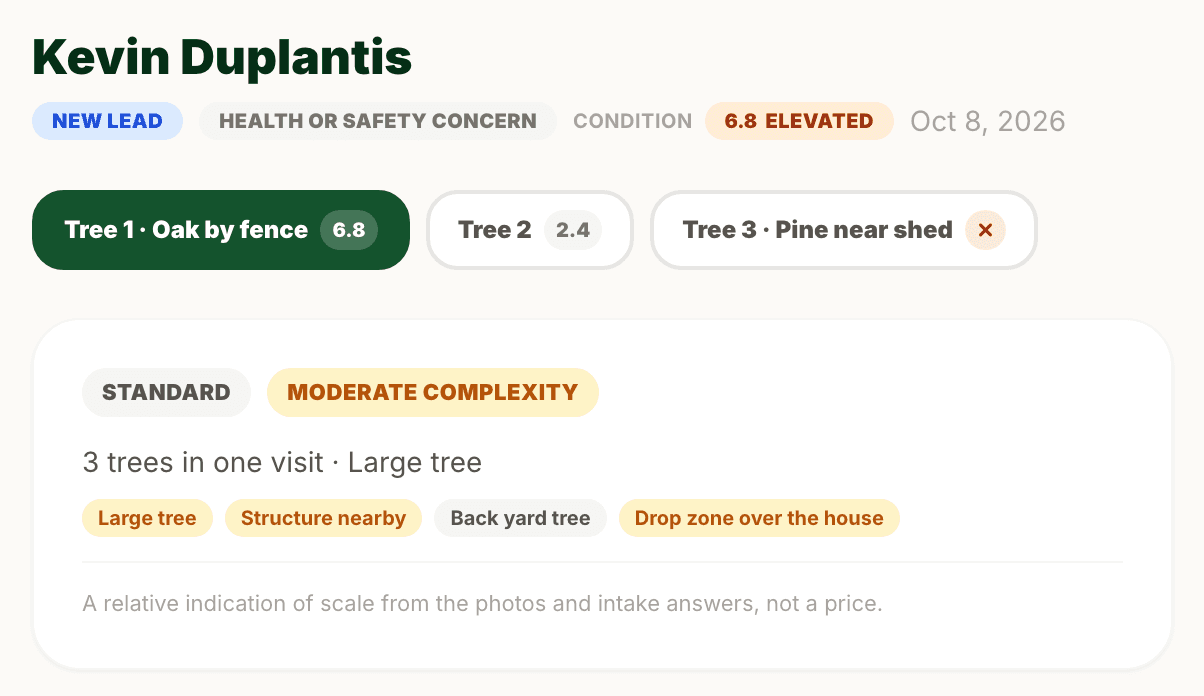
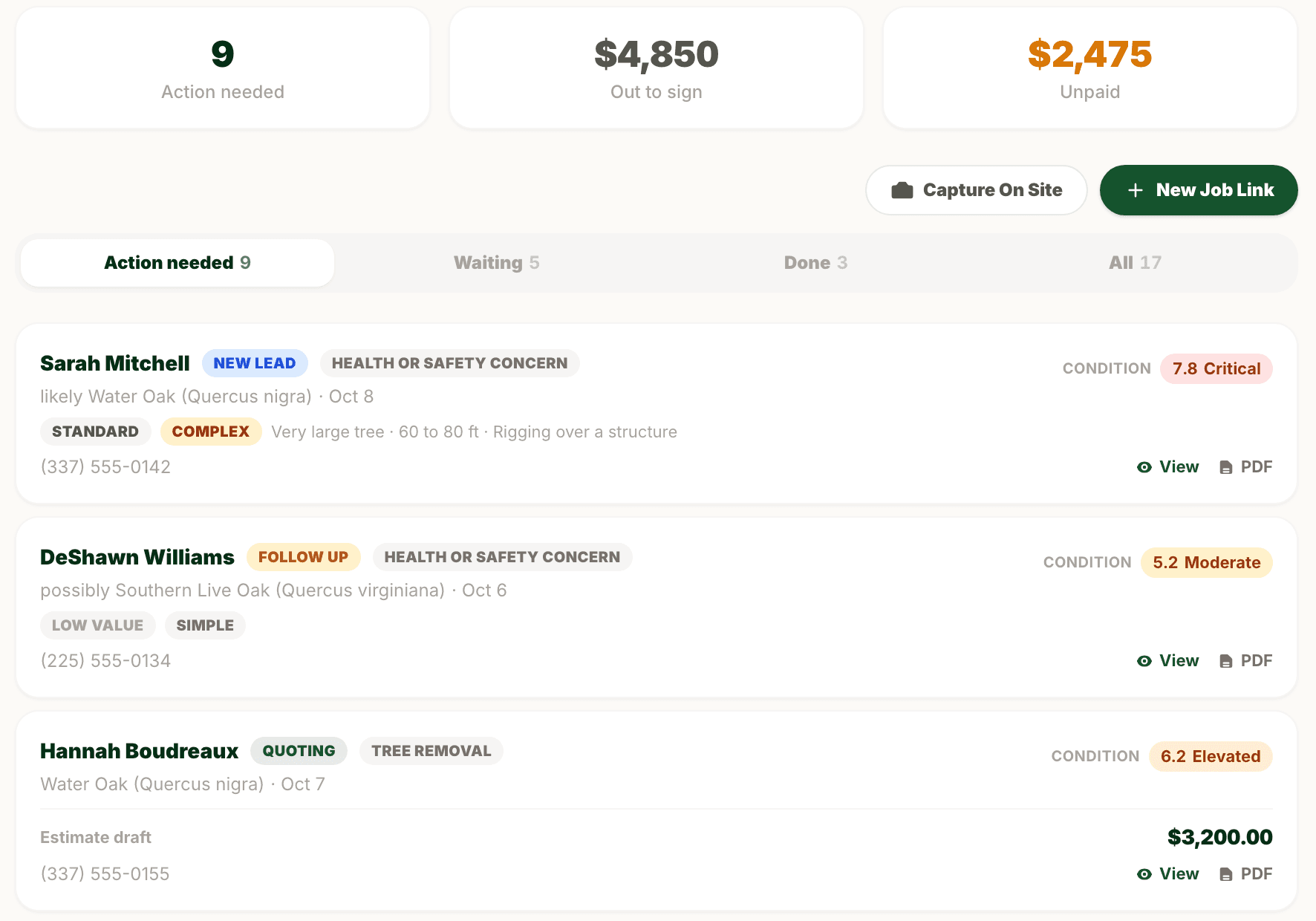
Each tree is analyzed in the background while you are on another job. By the time you open the dashboard, each new request carries a value band and a complexity rating, and flags like "tree may already be down" sit on the row itself, so you can sort the list before you open anything.
Open a job and the pre-visit brief makes the first cut: whether a remote estimate looks workable or an on-site visit is recommended, the equipment and crew it likely needs, what is worth raising before you quote, and what information is missing. It is not AI-written prose. It is a fixed set of rules applied to what the photos show and what the customer answered, so every line traces back to something that was seen or said, and the same request always reads the same way.
When you are ready to quote, the estimate opens with a labeled line for each tree, priced from your own rate card wherever you have set a rate, and goes to the customer as a proposal they can accept from their phone. You get an email the moment they do.
It is a preliminary screen, not a replacement for your judgment or for a site visit when the job calls for one. What it replaces is the drive to find out the tree was already down.
Frequently Asked Questions
Can you quote tree work from photos?
Will customers actually send photos?
What photos do you need to pre-qualify a tree job?
Should tree companies charge for estimates?
What is the biggest waste of time in tree service estimates?
Run a tree care business?
See which jobs are worth the drive before you leave the yard
Get Early Access →Branded intake link · Pre-visit brief · Estimate to invoice