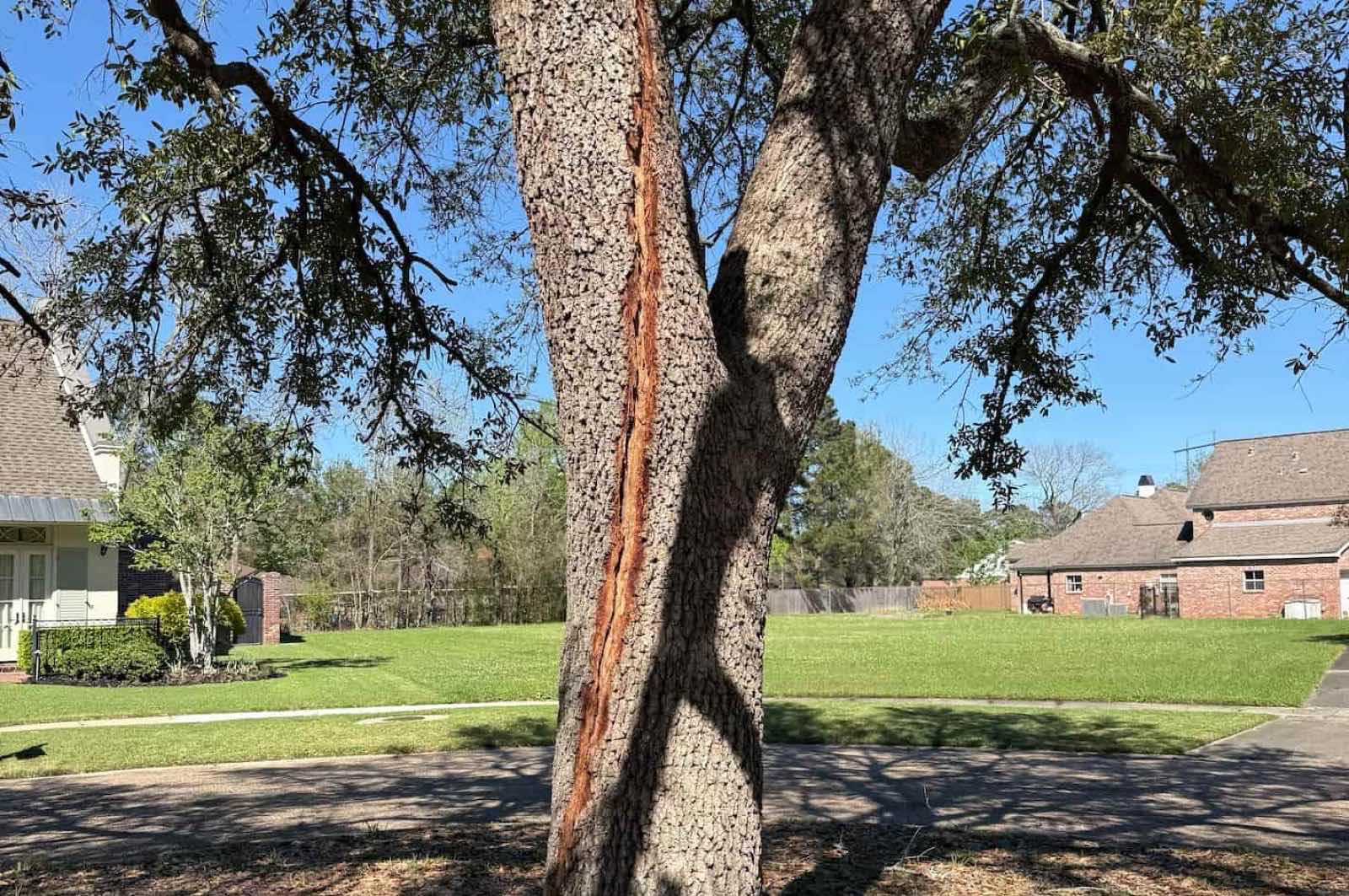
Most of the warning signs a tree gives you arrive slowly. Dieback creeps down the canopy over seasons. Internal decay works quietly for years before a mushroom appears at the base. A crack is different. A crack is not a forecast of failure so much as a record of one: wood that was carrying load has already come apart, and the seam you are looking at is where it let go.
That is why a visible crack or split sits at or near the top of the severity scale in most tree risk frameworks, including the scoring behind ArborScout. It is also why the single most useful thing to learn here is not how to worry about cracks, but how to tell a real one from the ordinary furrowed bark that every mature tree has. Homeowners make both mistakes: calling a tree service about deep oak furrows, and walking past a pinched seam in a branch union that is going to take half the tree down in the next big storm.
Bark Is Supposed to Look Like That
Start here, because it resolves a good share of the false alarms. Mature bark is not smooth. It is a rigid outer layer covering a trunk that keeps expanding, so it has to break somewhere, and every species has its own way of doing it. Oaks, ashes and cottonwoods develop deep vertical furrows separated by ridges. Shagbark hickory peels away in long strips. Sycamore and birch shed plates and sheets. None of that is damage. It is the tree making room to grow.
The reliable difference is whether the pattern repeats. Bark texture is a texture: it continues around the whole trunk in a consistent rhythm, the two sides of a furrow match, and the bottom of the groove is still bark. A structural crack is singular. It cuts across the surrounding pattern rather than joining it, it tends to run further and straighter than the furrows around it, and it frequently exposes pale wood instead of the darker inner face of bark.
The quickest check: look at what is at the bottom of the opening. If you can see bark, you are almost certainly looking at a furrow. If you can see wood, or the gap is deep enough that you cannot see the bottom at all, treat it as structural until someone tells you otherwise. Fresh cracks also have sharp edges; furrows and old seams have weathered, rounded ones.
Why Cracks Outrank Almost Everything Else
Wood is remarkably strong along the grain and much weaker across it, which is the same reason a log splits easily with a wedge and barely at all with a saw held sideways. A trunk works as a single column because its fibers are continuous. A crack ends that continuity. Load that used to spread across the full cross section now has to route around the gap, which means the wood beside the crack is carrying more than it was built to.
Cracks also concentrate stress at their tip, so they tend to extend rather than stabilize. And they do not extend at a steady rate. A crack can sit apparently unchanged for several years and then run a considerable distance in a single storm, which is what makes them so hard to judge by eye over time. Add the fact that an open crack is a direct route into the trunk for decay fungi and wood-boring insects, and a crack that has been there a while is often a crack with a hollow forming behind it.
Found a crack in your trunk?
Get a free AI risk assessment in minutes
Check My Tree Free →Preliminary screening · Takes 3 photos · No account required
The Crack Patterns That Matter
Where a crack sits and which direction it runs tells you far more than how long it is. These are the patterns worth being able to recognize, roughly in the order a tree care professional would want to hear about them.
Included bark at a tight V-shaped union
HighLooks like: Two trunks of similar thickness rising from one point, with a narrow V between them and a dark, pinched seam of bark running down into the crotch instead of a raised ridge of wood. Often there is no open crack yet at all.
Risk: This is the most common catastrophic split on suburban shade trees, and the fact that it usually looks like nothing is exactly the problem. Bark trapped between two stems means they were never properly joined: the union is a seam, not a weld. These fail in wind and ice, typically taking half the tree and leaving a large wound down the remaining trunk.
A crack running across the grain
UrgentLooks like: A crack that runs horizontally or diagonally across a trunk or major limb rather than up and down it. Sometimes there is a visible step or offset where one side has shifted relative to the other.
Risk: Cross-grain cracks are the serious ones. Wood separates along the grain fairly readily, so a crack cutting across it means the fibers themselves broke rather than pulled apart. An offset or step is worse still: it means the two sides have already moved, which is a failure in progress rather than a defect waiting to matter.
Two cracks on opposite sides of the trunk
UrgentLooks like: A vertical seam on one face of the trunk and a second one roughly halfway around, on the opposite side, at a similar height.
Risk: The worst geometry there is. Opposing cracks reduce what was one solid column into two half columns that can hinge against each other. This pattern is associated with sudden whole-trunk failure and is a reason to stay out from under the tree and keep others out until it has been assessed.
A crack at the base of a lean
UrgentLooks like: A crack low on the trunk on the side opposite the direction of lean, which is the side under tension. Frequently paired with soil that is cracked, lifted or mounded on that same side.
Risk: A tree in the act of failing. The trunk is being pulled apart on the tension side while the root plate gives way underneath. Combined with fresh soil disturbance this is among the most urgent things a homeowner can find, and it warrants clearing the fall zone first and calling second.
A crack that opens into a cavity, or sits beside a fungal conk
UrgentLooks like: A seam that widens into a visible hollow, or one running near shelf-like fungus on the trunk or root flare. Tapping the trunk nearby may sound hollow rather than solid.
Risk: A structural separation in wood that has already lost strength. These two defects compound rather than add: the crack routes load into the surrounding wood, and decay is what determines whether that surrounding wood can take it. This combination deserves prompt professional assessment.
A long vertical seam or frost crack
HighLooks like: A vertical split in the main trunk, often on the south or southwest face, sometimes with raised ribs of callus wood built up along both edges from years of reopening and closing.
Risk: Depth is what matters and you cannot see it from the outside. A shallow, weathered, well-ribbed seam is common on some species and many trees carry one for decades. A fresh, deep, open seam is a defect in the load-bearing column. The callus ribs are the useful clue: heavy ribbing means the tree has been managing it for years.
A lightning scar
HighLooks like: A strip of bark blown off in a straight or spiraling run down the trunk, exposed splintered wood underneath, and sometimes bark fragments thrown a surprising distance across the yard.
Risk: The visible damage usually understates the real extent, which often reaches the roots. Some struck trees survive and recover well. Others look acceptable for a season and then decline over the following two or three years. Worth an assessment soon after the strike and another the following year.
Short, shallow surface checks in weathered wood
LowLooks like: Fine, shallow cracks in exposed wood at an old pruning cut or a long-dead stub, grey and weathered, not extending into the living trunk.
Risk: Usually just the surface of dead wood drying and shrinking, which is normal and not a structural concern on its own. Worth noting if the stub is large or overhangs something, since dead wood fails for its own reasons, but the checking itself is not the issue.
The V and U Test
Of everything on this page, this is the one that pays off fastest, because it catches the failure mode that takes down the most suburban shade trees and it catches it before any crack is visible.
Look at where two large stems meet. A sound union is U-shaped: the two stems diverge with a rounded space between them, and there is a raised collar of wood in the crotch called the branch bark ridge. That ridge is the visible edge of wood that actually grew across from one stem into the other, year after year. A weak union is V-shaped: the stems press tightly together and the crotch holds a dark, inward-folded seam of bark rather than a ridge of wood. Arborists call the trapped layer included bark, and it means the two stems have been growing against each other rather than into each other.
Stem thickness matters too. A clearly smaller branch joining a clearly larger trunk is a strong attachment, because the trunk wood wraps around the branch base. Two stems of roughly equal diameter rising from the same point are called codominant, and neither is wrapping the other. Codominant stems with included bark between them are the classic split waiting to happen, and on fast-growing species like silver maple, Bradford pear and some elms the split is closer to an expectation than a risk.
Worth knowing: a V-shaped union with included bark can often be managed well if it is caught early, by reducing the weight the union carries and sometimes by adding support above it. Caught after it has begun to split, the options narrow considerably. This is the rare tree problem where looking up before anything goes wrong genuinely changes the outcome.
What Makes One Crack More Urgent Than Another
Two trees can both have a crack and be in completely different situations. These are the factors that move a crack up or down the list.
- Is it moving? A crack that is visibly opening or lengthening is in a different category from a stable one. Mark each end with chalk or a lumber crayon and write the date beside it, then check every few weeks and after every storm.
- Which direction does it run? Along the grain is common and sometimes tolerable. Across the grain means fibers broke, and it is the more serious finding.
- How much of the trunk does it involve? A seam on one face is one thing. A crack you can trace a long way around the circumference, or one with a partner on the opposite side, is another.
- Where does it end? A crack reaching the root flare or running into a branch union is worse than the same crack in the middle of a clean section of trunk, because those are the points already carrying concentrated load.
- Is anything coming out of it? Water, dark staining, ooze or sawdust-like frass suggest the crack connects to something internal: decay, a cavity or insect activity.
- Is it recent? Sharp edges, pale wood inside and no callus ribbing mean it is new, which usually means something recently changed. Weathered edges and heavy ribbing mean the tree has been living with it.
- What is underneath it? This does not change the tree, but it changes what the tree's failure would cost. It is half the risk equation and the half homeowners most often leave out.
Rank the trees in your yard by what is beneath them, not only by how bad they look. A moderate crack in a trunk that overhangs the driveway where your car sits every night outranks a worse one on a tree at the back fence line with nothing under it. Severity and consequence are separate questions, and both belong in the decision.
After a Storm, Cracks Are the Damage You Do Not See
Storm damage gets assessed by what came down. The branches on the lawn are obvious, they get dragged to the curb, and the tree is written off as having come through it. But a tree that kept its whole canopy can still have been loaded past what its unions could take, and the evidence for that is a crack rather than a pile of debris.
After serious wind or ice, walk the tree and look specifically at the major unions and the trunk. Fresh damage announces itself: pale wood inside the opening, sharp edges, no callus ribbing, sometimes sap or a wet streak running down the bark beneath it. Compare the tree against photographs from before if you have them. A union that has opened even slightly is worth a call, because the next storm arrives at a tree that starts with less strength than this one found.
Pair this with a check of the base for any new lean or soil movement, since storms tend to produce both at once, and a new lean with a fresh crack on the tension side is the combination that most warrants staying clear.
What Can Actually Be Done About a Crack
Worth being clear about what the real options are, because the internet is full of confident advice about cracked trees that was standard practice forty years ago and is not anymore.
Reducing the load
Usually the first move. Selectively pruning to shorten and lighten the limbs above a defect reduces the leverage working on it, both from the weight itself and from the sail area the canopy presents to wind. It does not close the crack, but it lowers the force trying to extend it, and for many trees it is enough to change the outlook substantially.
Cabling and bracing
For a tree worth investing in, hardware is a legitimate option. A cable installed high between two stems limits how far they can spread apart under load. A brace rod run through a union resists the split more directly. Both are real techniques with real track records, and both deserve honest framing: neither repairs anything. The crack stays where it is. What changes is how much the defect is allowed to move, and therefore how likely it is to fail.
Hardware is also a commitment rather than a one-time fix. Cables and rods need periodic inspection, typically annually, because they can loosen, corrode, get grown over by expanding wood, or fail at the anchor. A cabled tree is a managed tree. That is a perfectly reasonable thing to own, as long as you know that is what you are signing up for when you agree to it.
Removal
Sometimes the honest answer, particularly for a trunk that has split through a codominant union, a trunk with opposing cracks, or a crack combined with significant decay. Removal tends to come up more readily when the tree is over a house, a play area or a place people regularly park, because the consequence side of the equation is doing as much of the work as the defect itself.
What does not work
Filling a cavity or crack with concrete, expanding foam or sealant was common decades ago and is no longer recommended. It traps moisture against the wood, adds dead weight in exactly the wrong place, moves independently of a trunk that flexes, and makes future inspection impossible. Wound paints and tar likewise do not help a tree seal off damage and can slow the process down.
Do not strap or bolt a split tree yourself. Ratchet straps and chains wrapped around a trunk girdle the tree as it grows, and hardware under load on a trunk that is already failing is dangerous to be near. Bolting a union without knowing where the sound wood is can make the split worse by adding a second stress point. Professional cabling is anchored at specific heights, at specific angles, with specific hardware, and the engineering is the whole point of it.
What to Do If You Find a Crack
- Clear the area first if the crack is large, fresh, cross-grain, paired on the opposite side, or at the base of a lean. Move the cars, keep people off the patio underneath, and treat the fall zone as off limits until it has been assessed.
- Photograph it properly, straight on and from a fixed spot you can return to, with something of known size in frame for scale. Get the whole tree too, not just the crack, since where it sits on the tree is most of the story.
- Mark the ends with chalk or a lumber crayon and write the date next to the mark. Tracking whether it is extending is far more informative than any single look, and memory is not reliable for this.
- Check the rest of the tree while you are there, including every major union, the root flare for cracks or soil movement, and the canopy for dieback that might point to what is going on inside.
- Run a preliminary screen. ArborScout's free AI assessment looks for visible cracks and splits among the structural signs it evaluates and returns an indicative risk score from your photos. Three photos, no account, and it is a screening tool rather than a substitute for someone standing at the trunk.
- Call a tree care professional, and move faster for anything cross-grain, anything at the base, opposing cracks, or damage that appeared after a storm. Most will assess as part of providing an estimate, and a crack is one of the defects where an in-person look genuinely adds information that photographs cannot.
- Do not fill it, strap it, bolt it or paint it in the meantime. None of those improve the tree's condition and several make the eventual assessment harder.
Cracks are one of the seven signs a tree is at risk of failing, and they rarely show up alone. If you have found one, the rest of that list is worth a walk around the trunk.
Frequently Asked Questions
Is a crack in a tree trunk always dangerous?
How do I tell a real crack from normal bark furrows?
My tree split in a storm. Can it be saved?
Can a tree heal a crack?
Should I cable or brace a split tree instead of removing it?
How fast does a crack in a tree get worse?
Found a crack in your trunk?
Get a free AI risk assessment in minutes
Check My Tree Free →Preliminary screening · Takes 3 photos · No account required