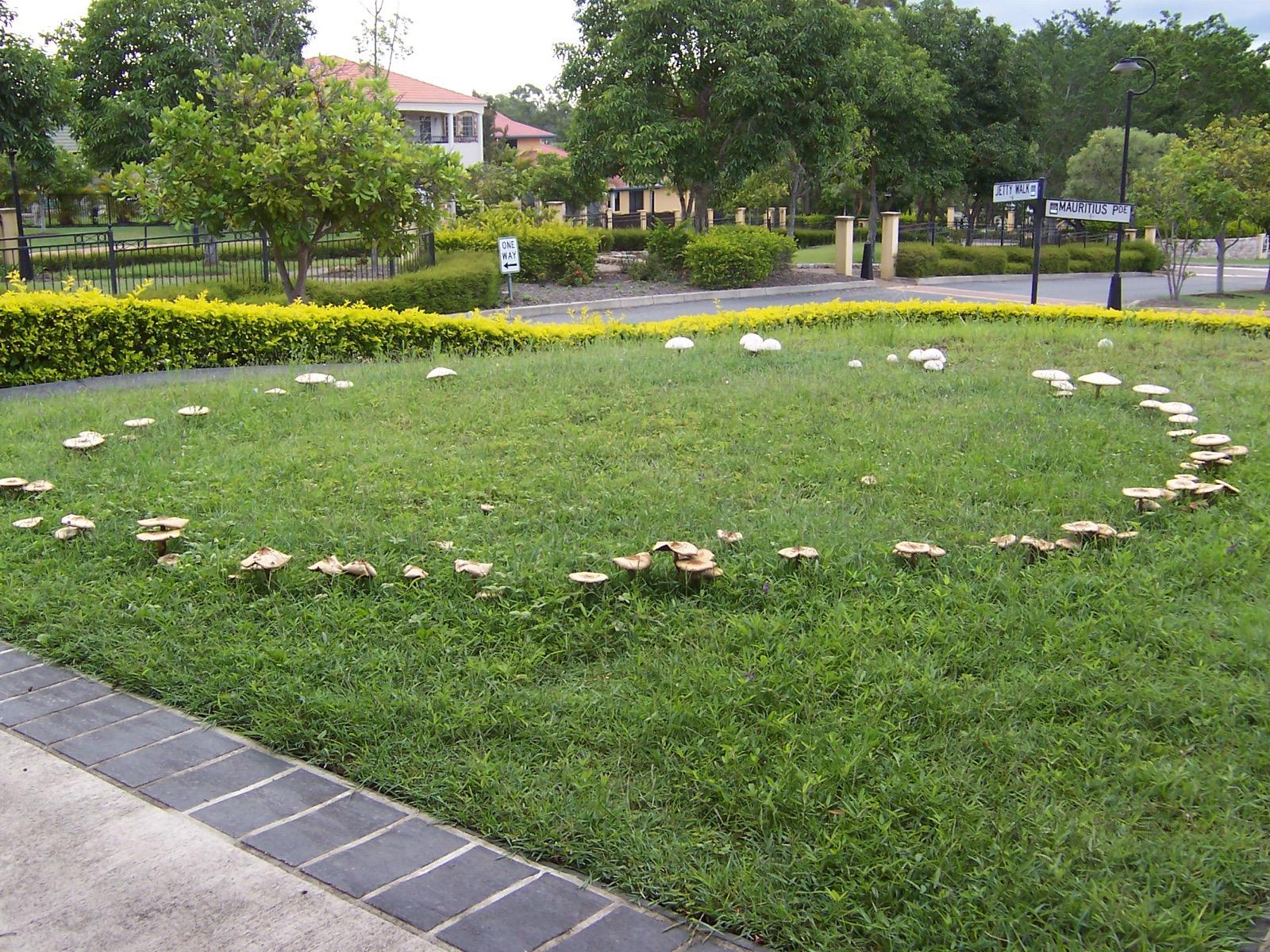
It rains for two days and the yard around the maple fills with mushrooms. You pull them up, mow over the rest, and after the next rain they're back. You're not doing anything wrong; that's just how mushrooms work. Once you know why, it's a lot easier to decide whether they need dealing with at all.
The short answer: mushrooms in the lawn or mulch around a tree are usually harmless and will keep returning after rain until whatever they're feeding on is gone. You can reduce them by removing buried wood, fixing wet spots and managing mulch. Mushrooms growing from the trunk or the base of the tree are a different matter, and removing them does nothing for the tree.
First: Where Are They Growing?
This decides everything else, so it's worth a careful look before you reach for the rake.
In the lawn or the mulch, not touching the tree
These are almost always fungi breaking down organic matter in the soil: an old stump or roots from a tree that was removed years ago, buried construction lumber, thick thatch, or the mulch itself. They're part of how soil recycles wood, and they do not attack the living tree. They're a cosmetic issue and, for some households, a pet and child safety issue.
From the trunk, the root flare or exposed roots
Mushrooms or shelf-like brackets growing out of the tree itself, or out of the soil right against the trunk where it flares into the roots, usually mean the fungus is living in the tree's wood. That's decay, and it matters for the tree's structure. Clusters of honey-colored mushrooms at the base are a common example: see honey fungus and Armillaria root rot. For the other species and what each one means, see mushrooms at the base of a tree.
If the mushrooms are growing from the tree, don't just remove them and move on. They're the one sign of internal decay you can see from outside, and pulling them off erases it without changing anything inside the wood.
Why Pulling Them Up Doesn't Work
A mushroom is the fruit of a fungus, the way an apple is the fruit of a tree. The fungus itself is a network of fine threads spread through the soil or the buried wood, and it lives there year round. When moisture and temperature are right, it sends up mushrooms to release spores. Picking the mushrooms is like picking apples: the tree doesn't mind, and there will be more next season, or in this case, after the next rain.
The fungus goes away when its food runs out. A thin layer of mulch might be used up in a season or two. A buried stump can feed mushrooms for years.
What Actually Reduces Them
Remove the mushrooms as they appear, if you need to
Pick, rake or mow them and bag them in the trash rather than leaving them on the lawn. This doesn't stop the fungus, but it keeps them away from dogs and small children, and it's the right first step if either might eat them.
Find and remove buried wood
Old stumps and roots are the most common food source. If a tree was removed in the last decade, the mushrooms may be tracing its root system. Grinding the remaining stump deeper and removing the chips and large root pieces shortens their run considerably.
Fix wet spots
Mushrooms need moisture. Water deeply and less often rather than a little every day, aim irrigation away from the trunk, and look at drainage where water stands after rain. Core-aerating a compacted lawn helps water soak in instead of sitting on the surface.
Manage the mulch
Keep mulch two to four inches deep and pulled back a few inches from the trunk. Thick, old, matted mulch holds water and feeds fungi; raking it to break it up, or replacing it, cuts the crop down. Mulch heaped against the bark in a volcano shape keeps the base of the trunk wet and is worth fixing for the tree's sake, not just the mushrooms'.
Let in light and air
Heavy shade and still air keep the ground damp. Raising the lower branches of the tree, done properly, or thinning dense shrubs around it lets the surface dry between rains.
Dethatch the lawn
A thick layer of thatch is organic matter sitting right at the surface. Removing it takes away another food source.
Mushrooms growing from the tree itself?
Get a free AI risk assessment in minutes
Check My Tree Free →Preliminary screening · Takes 3 photos · No account required
What Doesn't Work (and Can Hurt the Tree)
- Vinegar, baking soda and dish soap sprays. They may kill the mushrooms you hit, and the grass, but not the fungus in the soil. Vinegar is also hard on shallow tree roots.
- Bleach. Never pour it around a tree. It damages roots and soil life and doesn't solve the problem.
- Lawn fungicides. They're not a reliable way to stop mushrooms, because the fungus is feeding below the surface, and most of these fungi are harmless or beneficial anyway.
- Any spray or injection sold to stop decay inside a tree. No product reverses wood decay once it's established. If the mushrooms are coming from the tree, the useful next step is an evaluation, not a treatment.
A Few Common Visitors
Fairy rings
A circle or arc of mushrooms, sometimes with a ring of darker green or dead grass, is a fungus spreading outward through the soil. It's not a threat to the tree. Aerating, deep watering and even fertilizing help the lawn mask it; eliminating it means digging out the soil, which is rarely worth it.
Slime molds and stinkhorns in mulch
Bright yellow, foamy patches on mulch that look alarming are usually a slime mold, which is harmless and can be raked away. Stinkhorns, the smelly finger-shaped ones, are harmless too, just unpleasant. Both are signs of moist mulch doing its job.
Artillery fungus
If you're finding tiny black specks stuck to siding or cars near mulched beds, that is artillery fungus, which shoots its spores toward light-colored surfaces. It is harmless to the tree but hard to clean off. Raking the mulch regularly and switching to a different mulch, such as pine bark nuggets, often helps.
When to Call a Professional
Mushrooms in the lawn aren't a reason to call anyone. These are:
- Mushrooms or brackets growing from the trunk, the root flare, or exposed roots.
- Mushrooms at the base together with a thinning canopy or dead branches.
- Any fungus at the base of a tree that has started to lean, or has soil cracking or lifting around it.
- Loose or cracked bark at the base, especially with white, fan-shaped growth underneath it.
Any of those deserves an evaluation by a tree care professional, sooner if the tree could reach the house, the driveway, or where people spend time. For the broader list of what to watch for, see the seven warning signs a tree is at risk of failing.
Frequently Asked Questions
Are mushrooms around my tree bad for the tree?
Why do mushrooms keep coming back after it rains?
Does vinegar or baking soda kill mushrooms?
Should I use a fungicide on mushrooms in my lawn?
Are lawn mushrooms dangerous to dogs and kids?
How do I get rid of a fairy ring?
Mushrooms growing from the tree itself?
Get a free AI risk assessment in minutes
Check My Tree Free →Preliminary screening · Takes 3 photos · No account required
