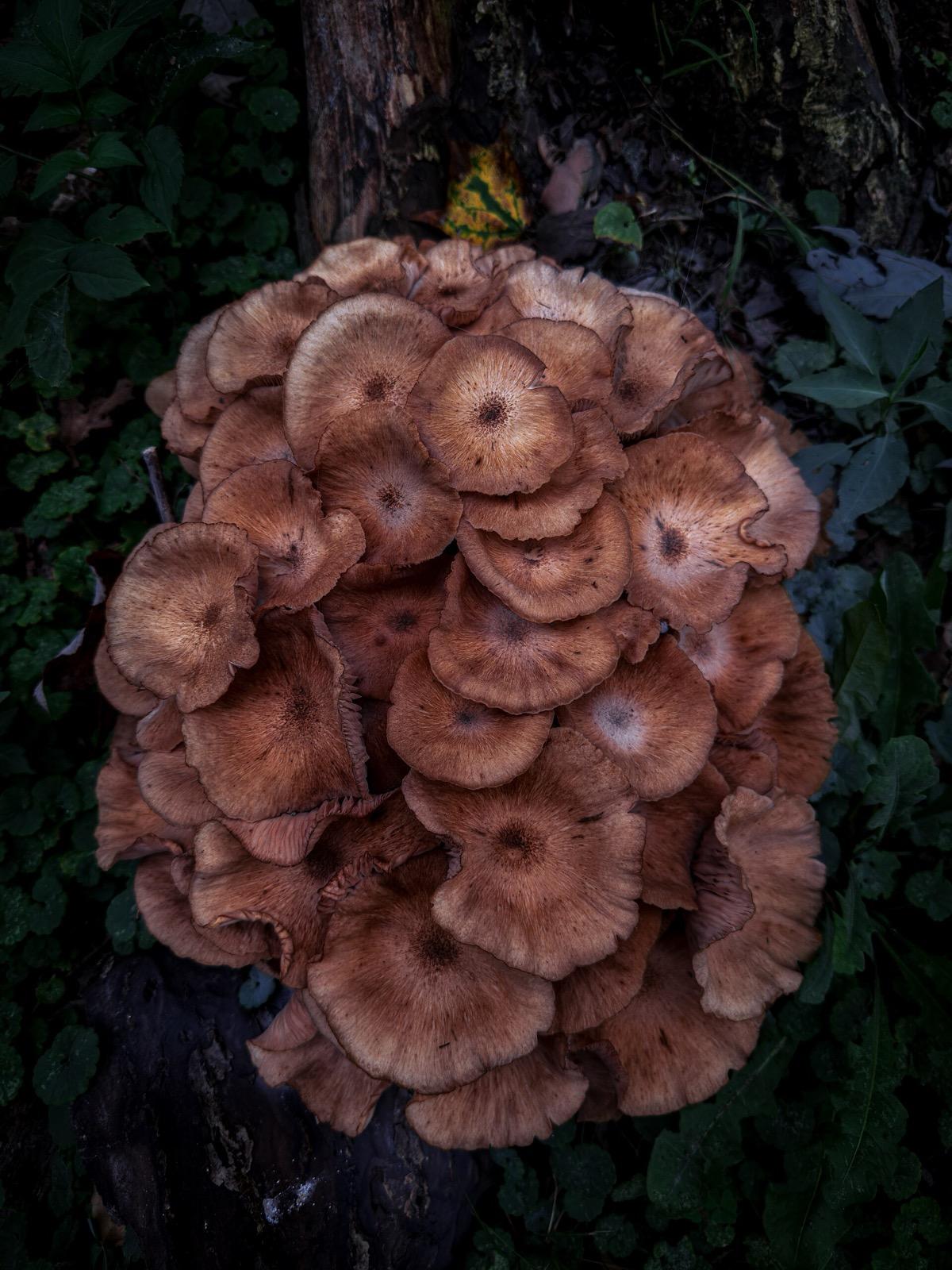
Every fall, a clump of tan mushrooms comes up around the base of the oak. They are gone in a couple of weeks, the tree leafs out again in spring, and it's easy to file them under “yard stuff.” If those mushrooms are honey fungus, they are worth more attention than that. They're the visible part of Armillaria, one of the most common root diseases of trees in North America, and the part of the tree it attacks is the part that holds it up.
This guide covers how to recognize honey fungus, how serious it is, and what you can still do about it. If you're not yet sure what kind of fungus you're looking at, start with our guide to mushrooms at the base of a tree, which covers the other common species too.
The short answer: honey-colored mushrooms growing in clusters from the base of a living tree usually mean the roots or the root collar are rotting. Removing the mushrooms doesn't help. What matters is how far the rot has spread and what the tree could hit if it fails, which needs a look at the base and, ideally, a tree care professional on site.
Mushrooms at the base of your tree?
Take three photos: the base, the trunk and the canopy. Get a free preliminary risk read in a few minutes. No account needed.
What Honey Fungus Is
“Honey fungus” is the common name for the mushrooms produced by fungi in the genus Armillaria. Several species occur across the United States. Some are aggressive and can kill healthy trees, especially conifers in the West. Others, including the ringless honey mushroom that's common on oaks across the Southeast, mostly take hold in trees that are already stressed. All of them do the same basic thing: they colonize and rot the roots and the base of the trunk.
The mushrooms are only the fruiting stage. The fungus itself lives in the wood and the soil year round, spreading through roots, and it only sends up mushrooms when conditions suit it, typically after rain in late summer and fall. By the time you see them, the fungus has usually been in the tree for a while.
How to Recognize It
You don't need a microscope. Honey fungus leaves several signs, and two or three of them together make a strong case.
Clusters of honey to tan mushrooms
Where to look: At the base of the trunk, on exposed roots, on a nearby stump, or in the lawn above roots a few feet out.
What you'll see: Tufts of mushrooms joined at the stem, with caps from honey yellow to tan or light brown, often with small darker scales near the center. Many species have a ring on the stem; the ringless honey mushroom does not. They appear mostly from late summer through fall.
White fans under the bark
Where to look: At the root collar, where the trunk meets the soil. Pry back a small piece of loose or dead bark.
What you'll see: Thin, creamy white sheets of fungus pressed between the bark and the wood, often fan-shaped, with a strong mushroom smell. This is the most reliable sign of Armillaria, because few other things look like it.
Black bootlaces
Where to look: Under loose bark at the base, and in the soil around the roots.
What you'll see: Dark brown to black cords, about the thickness of a shoelace, branching like roots. These are how many Armillaria species travel through the soil to new roots. Not every species makes them, so their absence proves nothing.
A tree in slow decline
Where to look: In the canopy, over one or more seasons.
What you'll see: Smaller or paler leaves, thinning foliage, dead branch tips, early fall color, or on conifers, resin oozing from the base. Root rot cuts off the water and nutrients the crown depends on, so the top of the tree shows what the roots are going through.
That last sign overlaps with plenty of other problems, which is why the mushrooms and the fans matter. If the canopy is what caught your eye, see what canopy dieback means for the other common causes.
Common lookalikes
Jack-o'-lantern mushrooms also grow in clusters at the base of hardwood trees and stumps, but they're a brighter orange and their gills run down the stem. They are poisonous. Many small brown mushrooms grow in lawns and mulch with no connection to the tree at all. If you can't tell, that's fine: for the tree, the useful question isn't the exact species but whether the fungus is growing from the tree's base and roots. If it is, the next steps are the same.
Don't eat mushrooms from your yard based on a photo or an article. Honey mushrooms have toxic lookalikes that grow in the same places. Keep children and pets away from them. If someone eats one, call Poison Control at 1-800-222-1222, or your vet for a pet.
Why It Matters: It Rots the Roots That Hold the Tree Up
Most decay fungi work on the trunk or branches, where the damage is at least partly visible. Armillaria works on the roots and the root collar, the part of the tree that anchors it in the ground. As the roots rot, the tree loses its grip on the soil, often without much warning above ground.
Trees with advanced root rot tend to fail in one of two ways: they tip over at the root plate, often in wet soil or high wind, or they snap low on the trunk where the decay has reached the root collar. Either can happen while the canopy still looks reasonably healthy, which is what makes root rot more dangerous than its appearance suggests. If the tree has also started to lean, read when a leaning tree is dangerous: a new lean combined with root rot is an urgent combination.
Armillaria also spreads. It moves from tree to tree through root contact and, in many species, through those bootlace strands in the soil, and it survives for years in old stumps and buried roots. One infected tree can be the source for the next.
What Lets It In
Many Armillaria species are opportunists. They're present in plenty of soils and take hold when a tree is weakened. The usual culprits:
- Drought, especially several dry summers in a row.
- Waterlogged soil, from poor drainage, a changed grade, or irrigation aimed at the trunk.
- Root damage from construction: trenching for utilities, a new driveway or patio, or heavy equipment compacting the root zone.
- Soil or mulch piled against the trunk, which keeps the root collar wet.
- Defoliation from insects or disease, and general old age.
That list is also the to-do list. For a tree with an early infection, removing the stress is the main lever you have.
Not sure how far it has gone?
Get a free AI risk assessment in minutes
Check My Tree Free →Preliminary screening · Takes 3 photos · No account required
What to Do Now
- Photograph the mushrooms where they attach, the base of the trunk, and the canopy. Note the date. Next fall's comparison is useful information.
- Check the root collar. Pull back mulch or soil from the base, and look for loose bark, cracks, or the white fans described above. Don't cut into healthy bark.
- Look at the canopy for thinning, dead branch tips, or a whole section that leafed out late.
- Think about the target. A tree that could reach the house, the driveway, a play area or a neighbor's property is a higher priority than one in the back of the lot.
- Get it evaluated. A tree care professional can probe the root collar, check the roots, and tell you whether the tree can be managed or should come down. Ask about an ISA tree risk assessment if the tree is large and close to something important.
- Remove the mushrooms if children or pets might eat them, and bag them. Just don't expect it to change anything for the tree.
Can the Tree Be Saved?
Sometimes, and it depends almost entirely on how far the rot has gone. There's no fungicide that cures an established Armillaria infection in a landscape tree. What helps is giving the tree the best chance to hold its own:
- Water deeply during dry spells, around the outer canopy rather than at the trunk.
- Pull mulch and soil back from the trunk so the root collar stays dry. Some tree care professionals excavate the soil around the root collar for the same reason; ask whether it makes sense for your tree.
- Protect the root zone from traffic, digging and new construction.
- Prune out dead wood, especially over places people use.
If the evaluation finds extensive rot in the major roots or the root collar, removal is usually the responsible call, especially near a home. A tree that has lost its anchor doesn't give much notice before it fails.
If the tree comes down
Ask for the stump and as much of the major root system as practical to be removed, not just ground to below the surface. The fungus can live on in leftover roots for years and infect whatever is planted next. Wait before replanting in the same spot, and when you do, ask a local nursery or extension office which species tend to tolerate Armillaria in your area.
Frequently Asked Questions
Is honey fungus serious?
Can a tree recover from Armillaria root rot?
How do I know the mushrooms are honey fungus?
Will honey fungus spread to my other trees?
Are honey mushrooms edible?
Does removing the mushrooms help?
For the full picture of what else to check on a tree you're worried about, see the seven warning signs a tree is at risk of failing.
Not sure how far it has gone?
Get a free AI risk assessment in minutes
Check My Tree Free →Preliminary screening · Takes 3 photos · No account required
