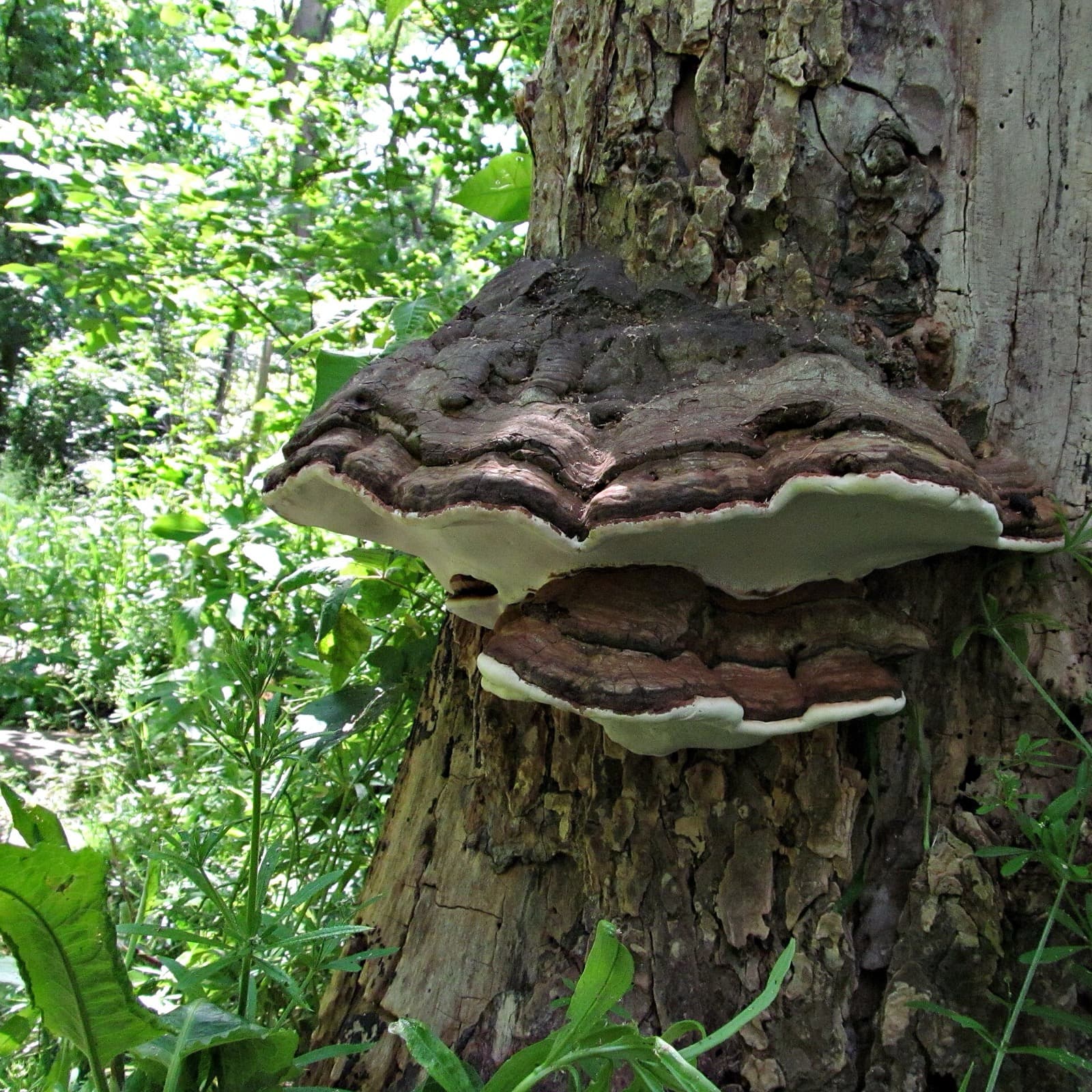
It looks like part of the tree: a hard, half-moon shelf sticking straight out of the trunk, maybe with rings or bands on top. Some people have had one for years and never thought about it. But a shelf like that isn't bark. It's the fruiting body of a fungus, and the fungus is living on the wood inside the tree.
That doesn't automatically mean the tree is coming down. Plenty of trees carry some internal decay for a long time. What matters is where the bracket is growing, what kind it is, and what the tree could hit.
The short answer: a shelf fungus on a living trunk usually means decay inside the wood. One on a dead branch is mostly a branch problem. One low on the trunk or at the base of a large tree, especially near the house or where people spend time, is worth having a tree care professional look at soon.
Bracket on your tree?
Take three photos: the base, the trunk and the canopy. Get a free preliminary risk read in a few minutes. No account needed.
What a Conk Actually Is
Arborists call these brackets “conks.” Most of the fungus is out of sight: a network of fine threads spreading through the wood and breaking it down. The conk is the part that comes outside to release spores. Some are annual and appear for a few months each year. Others are perennial: they stay on the tree and add a new layer every year, so a thick, layered conk means the fungus has been there a long time.
Decay fungi usually get in through a wound: a broken branch, a pruning cut, lawn mower damage at the base, roots damaged by digging. By the time a conk appears, the decay behind it is usually well established.
Where It's Growing Matters Most
On a dead branch, stump or fallen log
Lower concernThe fungus is breaking down wood that's already dead, which is its normal job. On a living tree, it mainly tells you that branch is dead. Have it pruned out if it hangs over anywhere people use.
On the main trunk, partway up
High concernDecay inside the trunk at that height. How serious it is depends on how much sound wood is left around it, which you can't tell from outside. Conks on more than one side of the trunk usually mean more extensive decay.
At the base of the trunk or on the root flare
Get it checked soonDecay in the roots or the lower trunk, the part that holds the tree up. This is the most serious location, because a tree with rotten roots can fail without much warning.
Common Kinds and What They Mean
You don't need an exact identification. Location tells you most of what you need. But if you can match what you see, these are some of the ones most often found on yard trees in North America.
Artist's conk (Ganoderma applanatum)
Looks like: A flat, hard, woody shelf, brown or gray on top with a white underside that turns brown when scratched. Perennial, often large, usually low on the trunk or at the base of hardwoods.
What it means: Decay of the heartwood and roots. At the base of a large tree, treat it as serious.
Varnish conk (Ganoderma, reddish species)
Looks like: A shelf with a shiny, reddish to dark brown top that looks almost lacquered, usually near the base or on surface roots.
What it means: Root and lower trunk rot. Common on hardwoods across the eastern US, and one to have checked when it's at the base.
Hen of the woods (Grifola frondosa)
Looks like: A large, ruffled, gray-brown cluster of many small overlapping caps, growing at the base of the tree, most often oaks, in late summer and fall.
What it means: Rot in the roots and the base of the trunk. It looks soft and harmless, and it's a sign of decay right where the tree is anchored.
Tinder conk and false tinder conk (Fomes, Phellinus)
Looks like: Hard, hoof-shaped brackets, gray to black on top, often cracked, growing directly out of the trunk. Tinder conk is common on birch and beech.
What it means: Decay inside the trunk. Perennial, so a large, layered one has been there for years.
Turkey tail (Trametes versicolor)
Looks like: Thin, leathery, fan-shaped brackets in colorful bands, often in large overlapping groups.
What it means: Mostly found on dead wood and stumps. On a living tree it usually marks a dead branch or a dead patch of wood, often around an old wound.
The bright orange chicken of the woods and the weeping conk found at the base of oaks are covered in our guide to mushrooms at the base of a tree, and clusters of tan mushrooms around the trunk are often honey fungus.
Some of these are collected for food or teas. Don't eat anything from your yard based on an article or a photo; several have lookalikes. If someone eats one and feels unwell, call Poison Control at 1-800-222-1222.
Not sure how serious it is?
Get a free AI risk assessment in minutes
Check My Tree Free →Preliminary screening · Takes 3 photos · No account required
What to Do
- Leave the conk on the tree. Knocking it off does nothing to the decay, and it's the best clue to what the fungus is.
- Photograph it where it attaches, the whole trunk around it, and the canopy. Note roughly how high up it is and which side of the trunk it's on.
- Look for company. Cracks, cavities, a new lean, dead branches in the crown or soil lifting at the base together with a conk make the case much more urgent.
- Think about the target. A conk on a tree over the house, the driveway or a play area is a higher priority than one at the back of the lot.
- Get it evaluated. A tree care professional can sound the trunk with a mallet, and some use tools that measure how much sound wood is left inside. Ask about an ISA tree risk assessment for a large tree near something important.
A conk with a crack or seam nearby deserves extra attention, because decay weakens exactly the wood a crack depends on. See which trunk cracks are dangerous.
Frequently Asked Questions
Is shelf fungus on a tree bad?
Can a tree with shelf fungus be saved?
Should I remove the shelf fungus from my tree?
Does the size of the conk tell you how bad the decay is?
Is shelf fungus contagious to other trees?
Not sure how serious it is?
Get a free AI risk assessment in minutes
Check My Tree Free →Preliminary screening · Takes 3 photos · No account required
