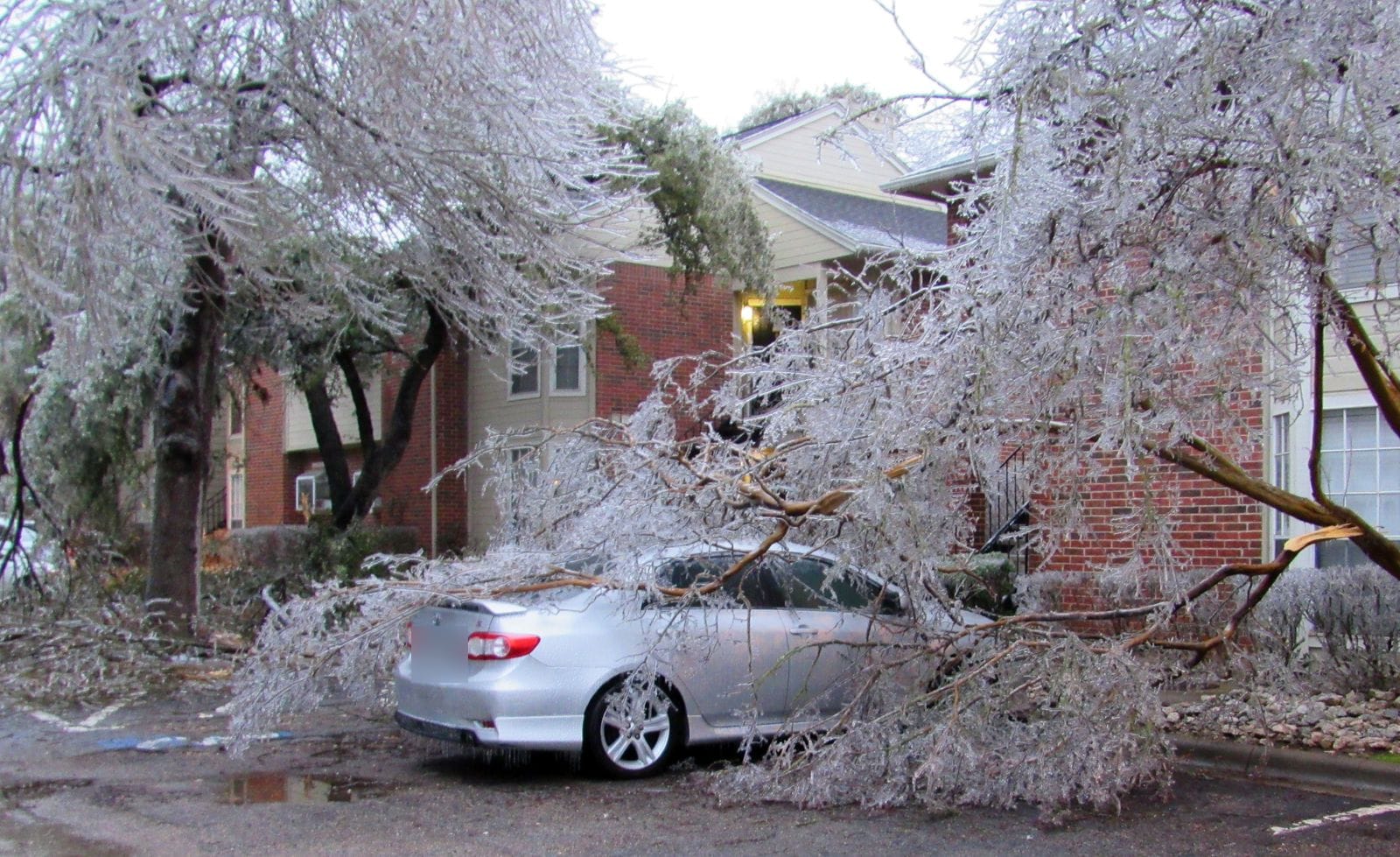
A coat of ice turns every twig and branch into a much heavier version of itself, and it does it to the whole tree at once. Wet, heavy snow does something similar. There's often no wind involved at all: the branches simply get heavier than the wood holding them up can carry.
Some trees bend under that weight and come back in spring. Others break, and they tend to break in predictable places. If you know where those are, you can do something about them before winter and know what to look for after.
The short answer: don't knock ice off branches or stand under loaded trees. Let it melt. Trees with tight V-shaped forks, weak wood or dead branches are the ones most likely to break. Once the ice is gone, check for broken branches still hanging in the canopy and splits at the forks.
Where Trees Break Under Ice and Snow
Extra weight finds the weakest point in a tree. These are the usual ones:
Tight V-shaped forks
Looks like: Two or more stems of similar size growing up from the same point, with a narrow angle between them. Sometimes bark is pinched into the joint, which arborists call included bark.
Why it fails: The stems are pressed together rather than joined by solid wood. Load both sides with ice and the fork can split straight down the middle.
Long, heavy limbs
Looks like: Branches that reach a long way out from the trunk with most of their weight near the end, often after years without pruning.
Why it fails: Weight at the end of a long lever. Ice adds load right where the branch is least able to carry it.
Dead and decayed branches
Looks like: Branches with no leaves in summer, peeling bark, or fungus growing on them.
Why it fails: Dead wood is brittle and decay has already weakened it. It's usually the first thing to come down.
Evergreens and multi-stem shrubs
Looks like: Arborvitae, junipers and other upright evergreens with several stems, which hold a lot of snow.
Why it fails: They tend to splay open and bend rather than break, though stems can split at the base under a heavy load.
For more on the forks most likely to split, see which cracks in a tree trunk are dangerous. For dead wood in the crown, see what dead branches in the canopy mean.
Which Trees Tend to Hold Up
Species matters, though a well-shaped tree of a weak species can outlast a badly shaped tree of a strong one. Lists vary by region, but extension services commonly put these groups on either side:
- More likely to break: Callery (Bradford) pear, silver maple, Siberian elm, willows, poplars and cottonwoods, hackberry, and other fast-growing trees with weak wood.
- Likely to bend: birches and other young, flexible trees. Many recover once the ice is gone.
- Tend to hold up better: many oaks, ginkgo, black walnut and other slower-growing trees with strong wood and well-spaced branches.
During the Storm
- Leave the ice alone. Iced branches are brittle, and hitting or shaking them breaks far more than the ice would.
- Stay out from under loaded trees, and don't park under them if you can avoid it.
- Light, fluffy snow can be brushed gently upward off small shrubs and low branches you can reach from the ground. Don't pull branches down to reach them.
- Stay well away from any branch on or near a power line, and call the utility. Ice brings down a lot of lines.
Branches keep falling for a day or more after an ice storm ends, especially as the ice starts to melt and as the wind picks up. A tree that looks fine the first morning may drop a limb that afternoon.
Worried about a tree before winter?
Get a free AI risk assessment in minutes
Check My Tree Free →Preliminary screening · Takes 3 photos · No account required
After It Melts
Once the ice is gone, walk around each tree and look up. You're checking for:
- Broken branches still hanging in the canopy. These are the most dangerous thing after any storm, and they're easy to miss.
- Splits at forks where two stems meet, which can be easier to see once the load is off.
- Torn bark where branches broke, and stubs that need a clean pruning cut.
- A new lean, or soil lifted at the base. Ice storms usually break branches rather than uproot trees, but wet ground makes it possible.
- Bent trees and shrubs. Give flexible ones until spring before deciding anything. Many straighten a good part of the way on their own.
A tree that lost some branches but has a sound trunk and most of its canopy usually recovers well with proper pruning. The full post-storm walk-through, including hiring help and what to photograph for insurance, is in our guide to checking a tree after a storm.
Before Next Winter
The best time to deal with ice damage is before the ice. A tree care professional can remove dead and weakly attached branches, reduce long heavy limbs, and on a valuable tree with a weak fork, install cabling or bracing to help hold it together. On young trees, structural pruning that picks one main stem early prevents the weak forks from forming in the first place. If a large tree with a tight fork stands over the house, it's worth having it looked at before the season starts.
Frequently Asked Questions
Should I knock ice off tree branches?
Which trees are most likely to break in an ice storm?
Will a tree bent over by ice straighten back up?
Can ice storm damage be prevented?
When should I have a tree checked after an ice storm?
Worried about a tree before winter?
Get a free AI risk assessment in minutes
Check My Tree Free →Preliminary screening · Takes 3 photos · No account required
